Particle (Basic ㊦ 84)
A particle which indicates that something is the only thing or state which exists, or the action someone will take, takes, is taking or took.
Equivalent: Only; just; be ready to do something; have just done something; just did something; be just doing something; about
| (i) Vinformal nonpast | ばかり | |
| 話すばかり | Be ready to talk | |
| (ii) Vて | ばかり | |
| 話してばかり | Be just talking | |
| 食べてばかり | Be just eating | |
| (iii) Vinformal past | ばかり | |
| 話したばかり | Have just talked | |
| 食べたばかり | Just have eaten | |
| (iv) {Adjective い informal nonpast/Adjectiveな stem} | ばかり | |
| 高いばかり | Just expensive | |
| 静かなばかり | Just quiet | |
| (v) Noun | ばかり | |
| 先生ばかり | Only teachers | |
| (vi) Noun+Particle | ばかり | |
| 学生にばかり | Only to students | |
| (vii) Quantifier | ばかり | |
| 一時間ばかり | About an hour |
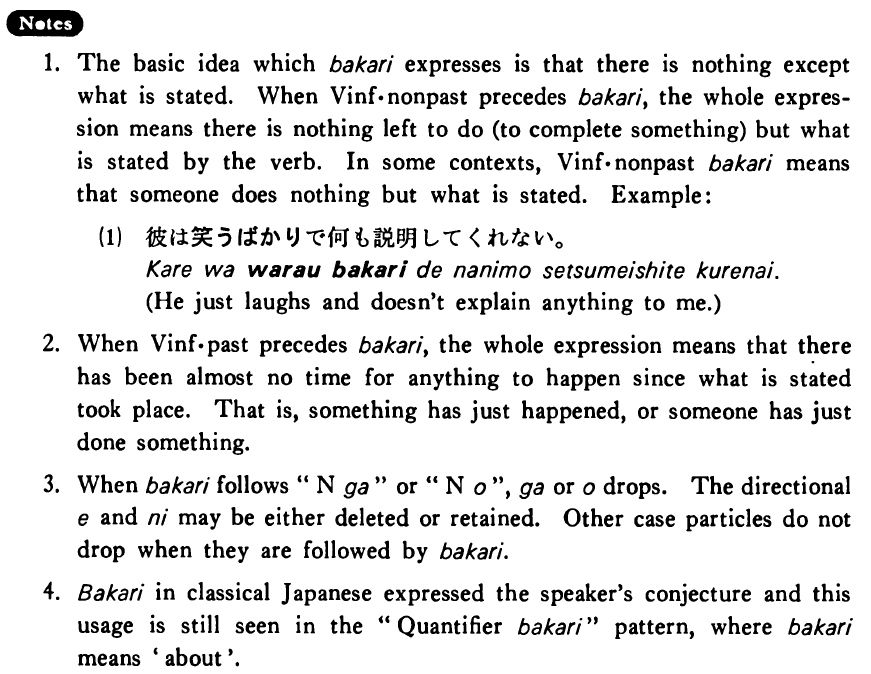
1. The basic idea which ばかり expresses is that there is nothing except what is stated. When Verb infornmal nonpast precedes ばかり, the whole expression means there is nothing left to do (to complete something) but what is stated by the verb. In some contexts, Verb informal nonpast ばかり means that someone does nothing but what is stated. Example:
2. When Verb informal past precedes ばかり, the whole expression means that there has been almost no time for anything to happen since what is stated took place. That is, something has just happened, or someone has just done something.
3. When ばかり follows "Nounが" or "Nounを", が or を drops. The directional へ and に may be either deleted or retained. Other case particles do not drop when they are followed by ばかり.
4. ばかり in classical Japanese expressed the speakers conjecture and this usage is still seen in the "Quantifier ばかり" pattern, where ばかり means 'about'.